



When?
06–17
JULY 2026
 Emotional
Throughout the activities, children build the confidence to try new things and learn that mistakes are a natural part of the learning process. They discover that inventors rarely succeed on the first attempt, but through persistence and the willingness to keep trying. The expedition encourages curiosity, initiative, and creative thinking. Children work in small teams, share responsibilities, and support one another as they explore and develop their ideas. At the same time, the activities strengthen communication and collaboration skills. Participants practice active listening, learn to give and receive feedback respectfully, and gain confidence in presenting their ideas.
 Expeditionary
 Learning is organized as an expedition into the world of ideas and inventions. Children investigate how inventions appear and how real-world problems can be solved through creativity and critical thinking. Participants experiment, design, and test ideas through a process of trial and improvement. They build models, explore technology, and discover how different systems work. These hands-on experiences help children connect ideas with real-world applications, refine their solutions, and learn from one another.
 Educational
During the week, concepts from engineering, technology, and history come together to help children understand how inventions emerge and evolve over time. Participants explore how innovative ideas have shaped the world and how different inventions have influenced everyday life. Through STEM-based activities, children build structures and models using materials such as LEGO and other construction resources, experimenting with simple engineering and mechanical principles. At the same time, they learn about the historical context in which certain inventions appeared and how they responded to the needs of society in different periods. Designing, testing, and improving their models helps children understand how an idea can develop into a practical solution.
EmotionalChildren develop self-confidence, empathy, and a sense that they can have a real impact on the world around them. Through collaborative activities, reflection, and exploration, they discover that every small gesture can make a difference. By the end of the expedition, each child leaves not only with new knowledge, but also with greater confidence in their own ideas.
Expeditionary Learning is organized as an expedition, where children discover and understand the world through direct experiences. Instead of simply receiving information, participants investigate, experiment, and work together to find answers to real questions about nature and the environment. Through hands-on activities and team projects, children explore natural processes, learn about recycling and sustainability, and discover how their ideas can contribute to protecting the planet. In this way, learning becomes meaningful and connected to the real world.
EducationalThe expedition combines science, creativity, and communication in an integrated learning process. Children explore concepts related to the environment, sustainability, and ecosystems. Through investigations, discussions, and practical projects, participants develop critical thinking, analytical skills, and problem-solving abilities. For older participants, the experience also includes a media and communication component, where they will express their ideas about protecting the environment. In this way, they discover that education is not only about gaining knowledge, but also about formulating ideas, communicating them clearly, and actively contributing to the changes that communities and our planet need.
 From Idea to Invention
Children explore how ideas are born and how they can be turned into practical solutions. Through observation, discussions, and creative activities, participants discover that many inventions begin with curiosity and the desire to improve the world around us.
 STEM Exploration
 Through STEM activities, children explore basic concepts in science, technology, engineering, and mathematics. Using construction materials such as LEGO and other practical resources, participants create models and structures while discovering how simple mechanisms work and how ideas can be transformed into real projects.
 Inventions That Shaped History
 Participants explore several inventions that have played a key role in the development of society and the historical context in which they appeared. Through stories and examples from the past, children discover how innovative ideas have influenced the way people live, communicate, and organize their lives.
Nature, Our Teacher Children discover nature through observation, exploration, and simple experiments. They will learn about natural processes such as the cycle of matter, the role of soil and plants, and how ecosystems function and maintain balance. Through activities such as environmental exploration and compost experiments, participants learn to see nature not only as a place to play, but as a complex system that we are all part of.
A Second Life for ThingsChildren discover the value of reuse and creativity. Everyday materials: cardboard, plastic, wood, and other recyclable objects become the starting point for constructions, creative projects, and small inventions. These activities encourage sustainable thinking and help children understand the impact of consumption.
Together for the PlanetWorking in teams to analyze environmental challenges and develop ideas that can help protect nature. Through this process, they discover that meaningful change often happens when people work together.

Groups for pupils aged 6 to 12 years.
The activities are conducted in Romanian.
If needed, activities can be assisted in English.
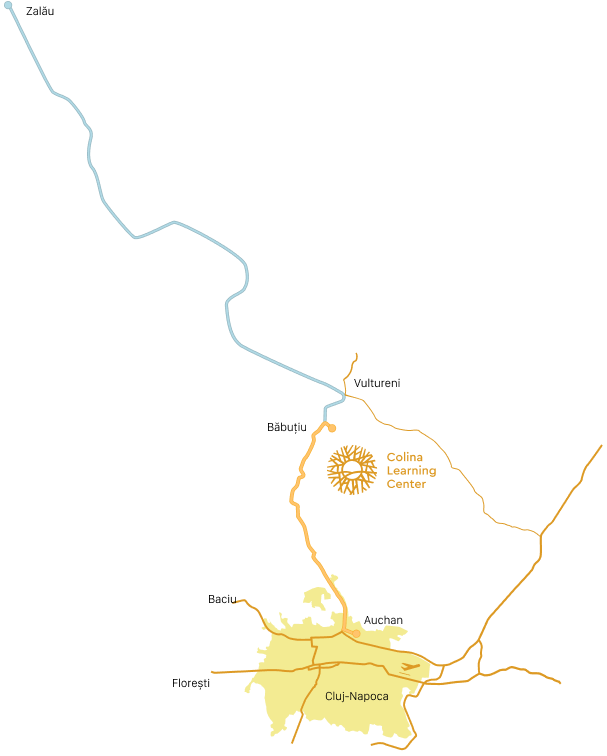
How do I get there from Cluj-Napoca?
|
Departures
CLUJ-NAPOCA Auchan Iris |
Return
Colina International School |
|---|---|
| 8:30 | 15:30 |

Where?
Băbuțiu (CJ)
Registration Fee
Full Price: 2500 RON
One week: 1500 RON
Siblings discount available